Lecture 1 Video 8 D- and L-Amino Acids
🧬 D- and L-Amino Acids — Complete Conceptual Overview


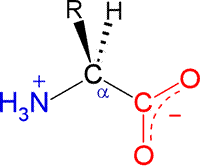

1️⃣ Basic structure of amino acids
All amino acids share the same core scaffold, built around a central carbon atom, called the C-alpha (Cα):
- Carboxyl group (–COO⁻) → gives amino acids their acidic nature
- Amino group (–NH₃⁺) → gives amino acids their basic nature
- Hydrogen atom (H-alpha)
- Variable side chain (R-group) → determines the amino acid’s identity and properties
👉 Because four different substituents are attached to C-alpha (except glycine), most amino acids are chiral.
2️⃣ Chirality and enantiomers 🪞
- Amino acids exist in two enantiomeric forms
- Enantiomers are non-superimposable mirror images, like left and right hands
- These two forms are called:
- L-amino acids
- D-amino acids
Even though D and L forms have the same atoms and bonds, their 3D arrangement differs, which has profound biological consequences.
3️⃣ How to determine D vs L configuration 🔄
To identify whether an amino acid is D or L, you must follow a specific spatial procedure:
- Orient the molecule so that the H-alpha points away from you, hidden behind the C-alpha
- Trace a path:
- From nitrogen (N) → carboxyl group (COO⁻)
- From carboxyl group → first atom of the side chain (R)
- From side chain → back to nitrogen
- Observe the direction of this path around C-alpha:
- 🔁 Counterclockwise → L-form
- 🔄 Clockwise → D-form
⚠️ This definition is independent of optical rotation (it does not mean left- or right-rotating light).
4️⃣ Relationship between D/L and R/S configuration
The absolute configuration of the C-alpha carbon can also be described using R/S nomenclature:
- For almost all amino acids:
- L-amino acids = S-configuration
- D-amino acids = R-configuration
🚨 Exception: cysteine
- Cysteine contains a sulfur atom in its side chain
- Sulfur has higher atomic priority than oxygen
- This flips the R/S assignment:
- L-cysteine = R
- D-cysteine = S
This is a classic exam-favorite exception.
5️⃣ Biological relevance 🧫
Ribosomal protein synthesis
- All ribosomally synthesized peptides and proteins are made exclusively from L-amino acids
- The ribosome cannot incorporate D-amino acids
This uniform chirality is critical for:
- Protein folding
- Secondary structure formation (α-helices, β-sheets)
- Enzyme specificity
Occurrence of D-amino acids
- D-amino acids do exist in nature, but:
- They are rare
- They are not produced by ribosomes
- They occur in non-ribosomally synthesized peptides
These systems are typically found in:
- Certain bacteria
- Specialized bioactive peptides (e.g., antibiotics, signaling molecules)
6️⃣ Big picture summary 🧠
| Concept | Key point |
|---|---|
| Core structure | C-alpha bonded to amino, carboxyl, H, and R |
| Chirality | Most amino acids are chiral |
| D vs L | Defined by spatial orientation, not optical rotation |
| Arrow method | Counterclockwise = L, clockwise = D |
| R/S link | L = S, except cysteine |
| Biology | Proteins use only L-amino acids |
| D-amino acids | Rare, non-ribosomal peptides only |